
Blog · 2026-11-23

Shoe stocklots: sizes, size curves and what to check before buying

Shoe stocklots: sizes, size curves and what to check before buying

Shoe stocklots look simple: a number of pairs, a brand and a price. But whether a footwear lot makes you money depends mostly on one thing – the sizes. In this guide we explain how shoe sizes and size curves work in wholesale, how to read a size breakdown, and the checklist we recommend before you buy any shoe stocklot.

Why sizes matter more than the price per pair

Two lots of the same model at the same price can perform completely differently. One sells out in a few weeks; the other leaves you with a shelf of size 36 and size 47 that nobody asks for. With clothing, a slightly wrong size mix is annoying. With shoes it is expensive, because:

  • every size is a separate product – a customer who needs a 43 will not buy a 41;
  • shoes take a lot of storage space in their boxes;
  • the sizes that sell first are the same in almost every shop, so the "leftover" sizes are hard to pass on to other resellers too.

That is why an experienced buyer always asks for the size breakdown first and only then looks at the price.

Shoe size systems in a nutshell

Stocklots often come from different markets, so you will see several size systems on boxes and in product lists:

  • EU sizes (e.g. 36–47) – the standard in most European shops.
  • UK sizes (e.g. 3–12) – common on British and many sports brands' labels.
  • US sizes – separate scales for men and women, which causes the most confusion.
  • CM / Mondopoint – the foot length in centimetres, printed on many sneaker labels.

Conversions are not identical between brands, so always use the size chart of the specific brand when you list the shoes in your shop.

Unisex sizing – the Converse example

Some models are sold in unisex sizes. Classic Converse Chuck Taylor All Star shoes are labelled in US men's sizes; a woman usually takes two US sizes more than the label shows (US men's 5 ≈ US women's 7). Chuck Taylors are also generally known to run about half a size large. Unisex models are great for resellers: one size run covers men and women, so fewer pairs remain unsold.

What is a size curve?

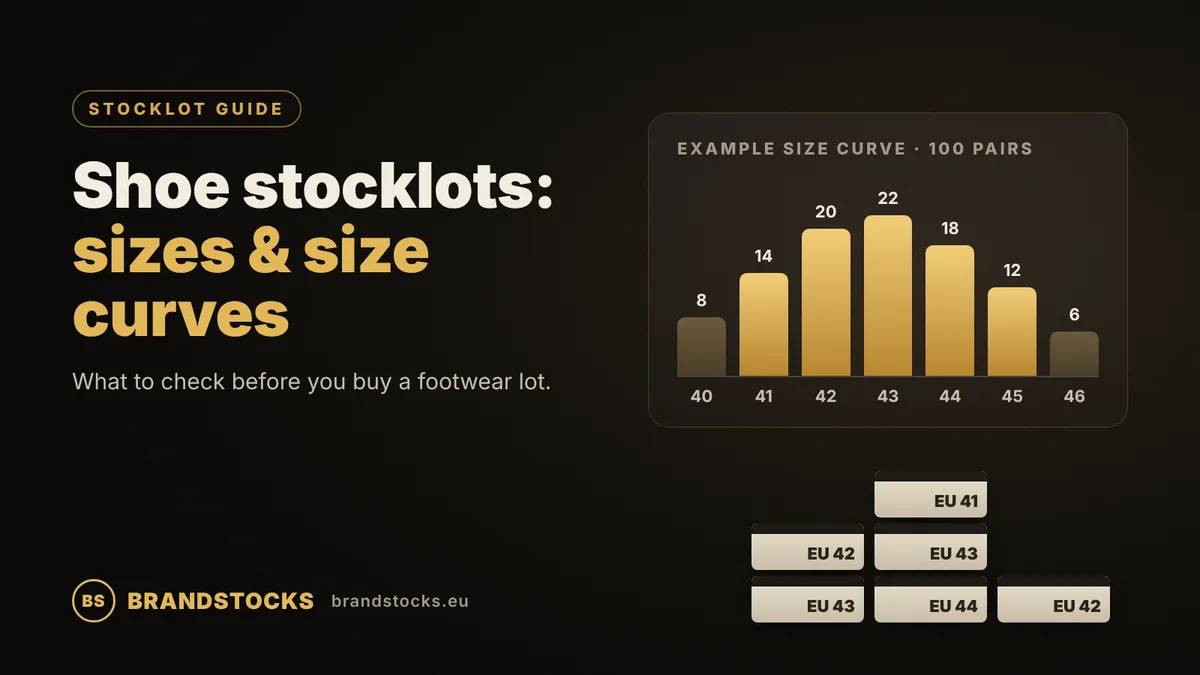
A size curve (or size run) is the distribution of pairs across sizes in a lot. Shops sell the middle sizes much faster than the smallest and largest ones, so a healthy lot has most pairs in the middle and fewer at the edges – it looks like a curve or a bell.

Typical well-selling ranges in Europe (as a rough guide – your own sales data is always better):

  • Men's shoes: EU 40–46, with the strongest sizes around 42–44.
  • Women's shoes: EU 36–41, with the strongest sizes around 37–39.
  • Unisex sneakers: EU 36–46, with two peaks – one in the women's and one in the men's range.
  • Kids' shoes: spread over a wider range, with smaller quantities per size.

A balanced men's lot of 100 pairs could look like this: 40: 8 · 41: 14 · 42: 20 · 43: 22 · 44: 18 · 45: 12 · 46: 6. Most pairs are in 42–44, and the edge sizes are still present, so you can serve almost every customer.

How to read a size breakdown

A size breakdown is a list of every model in the lot with the number of pairs per size. When you receive one, look at four things:

  1. Total per size: add up all pairs per size and compare it to the curve above. Is the middle strong, or is the lot "heavy" on the edges?
  2. Broken size runs: are there models with only one or two sizes left? These are harder to sell, because a customer who likes the model often cannot find their size. They are fine at a lower price, or for outlet and market selling.
  3. Pairs per model: 2–3 pairs of 40 different models is a very different business from 40 pairs of 2 models. Many models are good for webshops with a wide offer; few models in depth are good for shops and marketplaces.
  4. Gender split: how many pairs are men's, women's, kids' or unisex – and does that match your customers?

At Brandstocks every footwear lot comes with a size breakdown and photos, so you can do this check before you order.

Checklist: what to check before buying a shoe stocklot

1. Sizes and quantities

  • A complete size breakdown per model, not just a total number of pairs.
  • The size system used (EU, UK, US men's/women's, unisex).
  • How many pairs fall into your best-selling sizes.

2. Condition and grade

  • New with box, new without box, or damaged box – each sells at a different price.
  • Customer returns or B-grade goods should always be stated clearly.
  • Ask for photos of a few random pairs and boxes, not only of the best ones.

3. Authenticity

  • Labels inside the tongue with style code, size and production details.
  • Box labels that match the shoes inside (style code, colour, size).
  • A supplier who can tell you where the goods come from (overstock, end of season, outlet, retailer clearance).

4. Season and age of the stock

  • Classic, all-year models (like the Chuck Taylor All Star) keep their value; very seasonal or trend models lose it faster.
  • Check whether the models are winter or summer shoes and when you will be able to sell them.

5. Packing, volume and shipping

  • How the shoes are packed (in original boxes, in cartons, on pallets).
  • The number of cartons or pallets – shoes in boxes take a lot of space, which affects shipping costs and your storage.
  • Ask for the shipping cost to your address before you pay.

6. The numbers

  • Calculate your price per pair including shipping.
  • Estimate your selling price for the strong sizes and a lower price for the edge sizes and broken runs.
  • If the lot only works when every single pair sells at full price, it is probably too expensive.

Single-model lots or mixed lots?

Single-model lots (one style, full size run) are easy to list online and easy to reorder, and they work well for shops and marketplaces. Mixed lots (many styles, fewer pairs each) give your shop variety and usually a lower price per pair, but they need more work: more photos, more product pages and more size management. Choose the type that fits how you sell.

Buying shoe stocklots from Brandstocks

We sell authentic branded footwear to registered businesses across the EU. Every lot is listed with sizes, quantities and photos, and our team speaks English, Hungarian and German if you have questions about a lot. See our current offers on the shoe stocklots and Converse stocklots pages.

Register your company for free to see our wholesale prices and order online – and subscribe to our newsletter to get new shoe lots first.

← All articles

Popular searches